
Concrete Driveways in Melton
Melton sits on reactive clay that moves with the seasons. A driveway here is only as good as the base under it and the joints cut into it — everything else is finish.
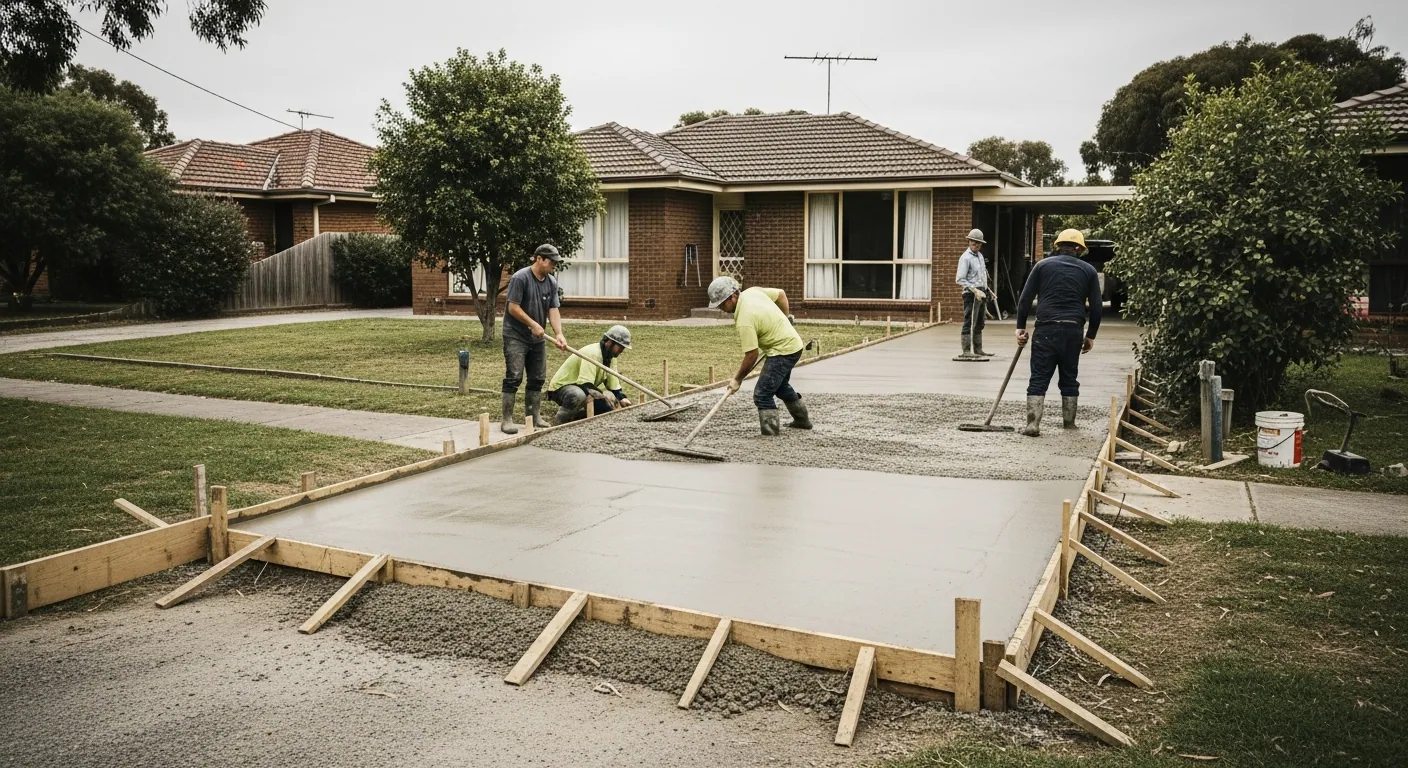
The base matters more than the concrete
Almost every failed driveway we are called to look at failed from underneath.
Melton sits on the eastern edge of the Victorian Volcanic Plains, and the soils are basalt-derived cracking clays — Vertosols, which shrink and swell considerably through wetting and drying cycles, with cracks running from the surface deep into the subsoil. Long dry summers followed by wet winters make that movement pronounced. A slab laid on uncompacted or poorly prepared ground rides it and cracks.
The standard most concreters cite is the wrong one
You will often see AS 2870 quoted for driveways. AS 2870 is the footing standard for houses — it governs your home's footings, not your driveway. The residential pavement standard is AS 3727.1.
And here is the part that matters in Melton: AS 3727.1 explicitly excludes Class H1, H2, E and P sites from its deemed-to-satisfy provisions. Melbourne's west runs predominantly Class M and H1, with H2 through the older Werribee and Wyndham flats and P classifications on former farmland fill. So on a great many blocks around here, the standard tables simply do not apply and the pavement warrants proper design rather than a default thickness.
AS 3727.1 also excludes concrete pavements that rely on fibres as the sole reinforcement — worth knowing, because fibre-only driveways get sold on price fairly often.
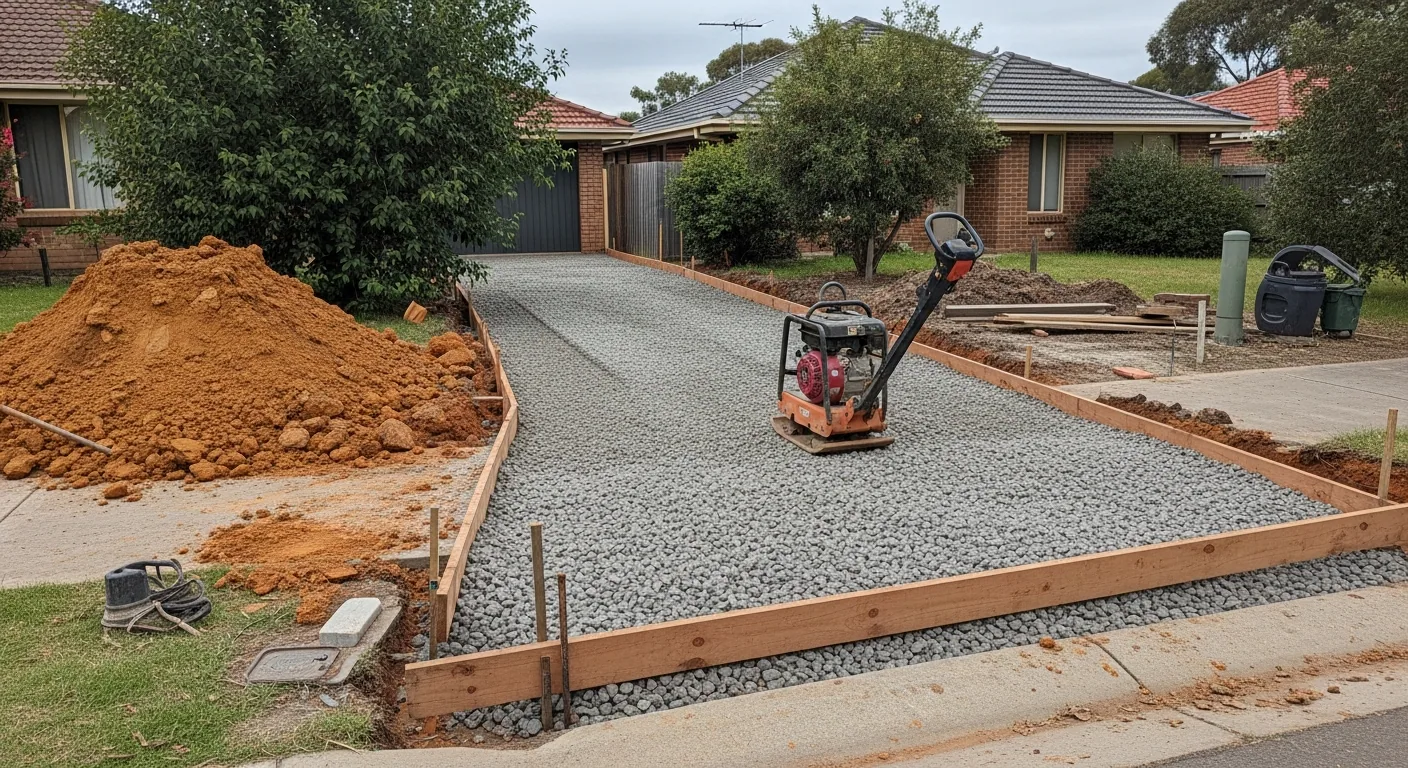
So the work that determines whether your driveway lasts happens before any concrete arrives:
Excavate to depth rather than skimming the topsoil
Compacted crushed rock base, properly rolled in layers rather than tipped and raked
Fall away from the house, so water is not delivered to your own footings
Trenches backfilled and compacted where the slab crosses service, sewer or drainage runs — this is a specific council requirement on the crossover and good practice on the driveway
Edges formed true, because a slab that is thin at the edge cracks at the edge
For reference, council's own crossover standard requires 125 mm of 25 MPa concrete over 50 mm of compacted Class 3 crushed rock, with SL72 mesh on bar chairs. That is a sound benchmark for the driveway behind it too.
Reinforcement and joints
Mesh does not stop concrete cracking. Concrete shrinks as it cures, and it will crack somewhere. What reinforcement does is hold the crack tight so it stays a hairline rather than opening into a step you can feel through the steering wheel. Mesh needs to sit correctly — on chairs, in the upper part of the slab with proper cover — not thrown in and walked on.
Joints decide where those cracks happen. Control joints (weakened plane joints) create a deliberate line of weakness so the slab cracks there, straight and unnoticed, instead of wandering across the middle. Expansion joints let neighbouring slabs move independently.
Get the joint spacing wrong and you get random cracking. It is the single most common defect we see on driveways poured by whoever was cheapest.
Where drainage fits in
On reactive clay, the driveway is part of your drainage whether you planned it that way or not. A large impermeable slab redirects a lot of water.
Two things worth getting right: falls that take water away from the house rather than towards it, and a legal point of discharge that the driveway does not obstruct — council requires 1.0 metre clearance from the back of kerb legal point of discharge for the crossover, and the same logic applies behind it.
Getting this wrong does not just damage the driveway. Concentrating water against one side of a house on reactive clay is a leading cause of footing movement, which is a far more expensive problem than concrete.
Finishes
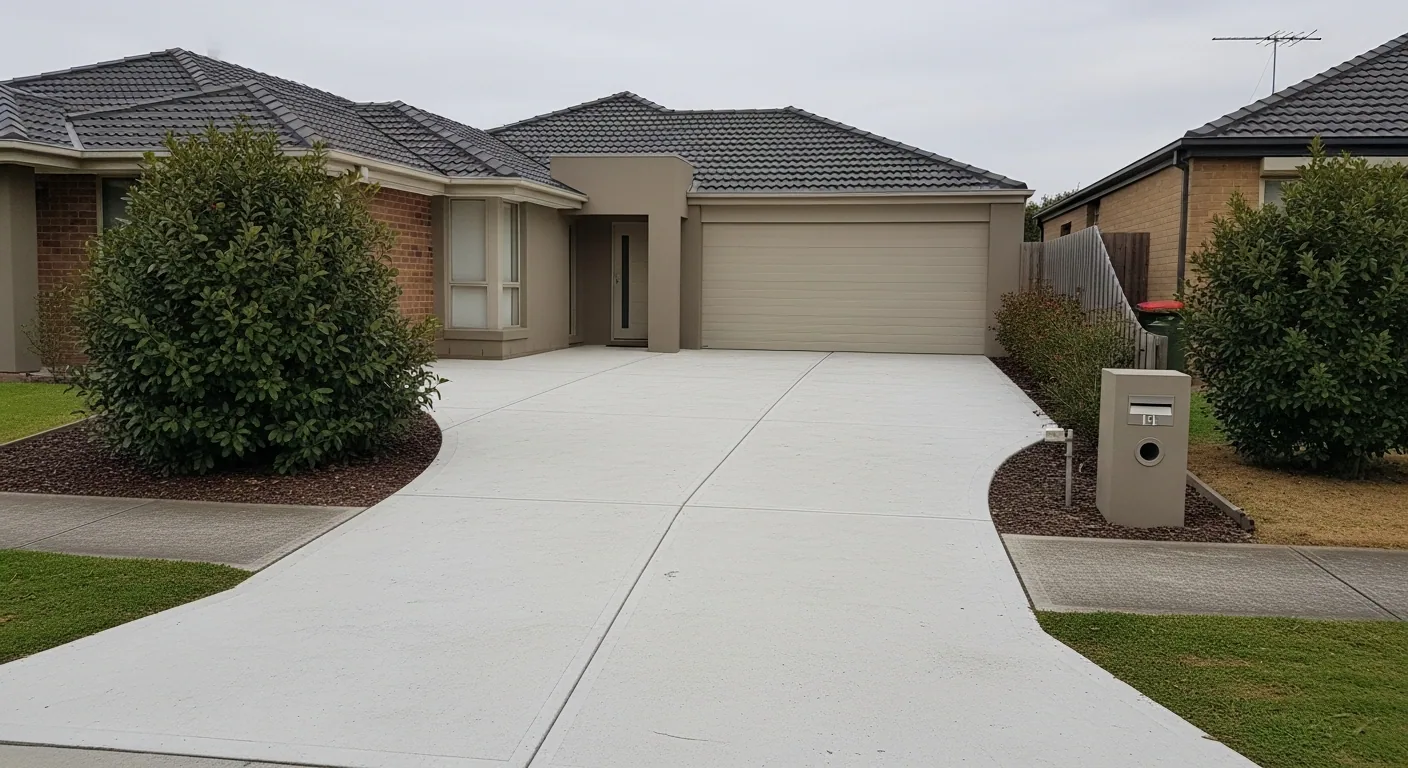
Inside your property boundary you have real choice — plain, coloured, exposed aggregate, honed. We cover the decorative options on their own page.
One constraint to know now: the crossover section between your boundary and the kerb cannot be coloured or pattern-paved. Council's standard drawing prohibits it, and where a footpath exists or is likely, the crossover must be plain concrete or match that footpath. So the usual Melton arrangement is a decorative driveway that runs to the boundary and a plain crossover beyond it. Done deliberately, with the joint on the boundary line, it reads as a design choice rather than a compromise.
What drives the price
We quote on site rather than by the square metre over the phone, because the variables genuinely change the number:
Area and shape — a simple rectangle is cheaper per square metre than a curved drive with multiple returns
Excavation depth and disposal — how much spoil has to leave the site
Base depth, which on more reactive ground needs to be deeper
Reinforcement specification
Finish — plain is the baseline; exposed aggregate, colour and honing each add cost
Access — whether a truck can get to the pour or it has to be barrowed
Existing driveway removal, if there is one to break out and cart away
Whether the crossover is included, which brings council approval, consent and inspection into scope
Ask any quote you are comparing to state the concrete strength, the slab thickness, the base depth and the reinforcement. Two quotes that look far apart are often quoting genuinely different slabs.
Curing: when can you drive on it?
The number people want, and the one most contractors fudge.
The Cement Concrete & Aggregates Australia guidance is that a pavement should not be trafficked until it has gained 60 per cent of its specified 28-day strength, which is usually about seven days after placing. So for a normal car, seven days is the figure to plan around.
Two things worth separating, because they get conflated constantly:
Curing is keeping the concrete moist so it develops properly. It runs a minimum of three days, and seven in hot, windy or coastal conditions, starting within about three hours of finishing.
28 days is not when concrete "finishes". It is the reference age at which the specified strength is verified — N25 means 25 MPa *at 28 days*.
For heavy vehicles, a caravan or a loaded truck, the industry convention is to wait out that 28-day milestone. There is no Australian standard that sets a foot-traffic figure; 24 to 48 hours is convention rather than a rule, and we will tell you that rather than pretending otherwise.
Cold weather slows all of it, and Melton winters are genuinely cold, so we give you dates for your actual pour rather than a rule of thumb.
Why choose us for concrete driveways
- Compacted crushed rock base built for reactive clay, not a skim of topsoil
- Mesh on chairs with correct cover, so cracks stay hairline
- Control joints set out deliberately, not left to chance
- Falls planned away from the house — water is a footing problem, not just concrete
- Quotes state strength, thickness, base depth and reinforcement
Concrete Driveways — common questions
How much does a concrete driveway cost in Melton?
It depends enough on the site that a phone number would be misleading. The variables that actually move it are area and shape, excavation depth and spoil disposal, base depth, reinforcement, finish, truck access, whether an old driveway has to come out, and whether the crossover is included. We quote on site. When comparing quotes, ask each one to state the concrete strength, slab thickness, base depth and reinforcement — that is usually where the difference lies.
How long before I can drive on my new driveway?
Concrete gains strength over time, and the reference point in the specification is 28 days, which is when 25 MPa is measured. Foot traffic comes much earlier, and light vehicles some days after the pour, but heavy vehicles are what damage a slab that has not reached strength. We give you specific dates for your pour, because weather matters — cold Melton winters slow curing noticeably.
Why do concrete driveways crack?
Concrete shrinks as it cures, so it will crack somewhere — the job is controlling where. Control joints create a deliberate line of weakness so the crack forms there, straight and barely visible. Reinforcement holds cracks tight rather than preventing them. Random cracking across a slab usually means joints were badly spaced, the base was poorly compacted, or the mesh was not properly positioned. On Melton's reactive clay, base preparation is the biggest single factor.
Does Melton's clay soil affect my driveway?
Considerably. Reactive clay swells when wet and shrinks when dry, and Melton's long dry summers and wet winters make that cycle pronounced. A slab on poorly prepared ground moves with it and cracks. That is why we excavate to depth and compact a crushed rock base in layers rather than tipping and raking, and why joint spacing matters more here than it would on stable ground.
Can I have exposed aggregate all the way to the street?
Up to your property boundary, yes. Beyond it — across the crossover to the kerb — no. Council's standard drawing MCC 501 states no pattern-paved finish or coloured concrete is to be used, and where a footpath exists or is likely the crossover must be plain concrete or match that footpath. The usual arrangement is decorative to the boundary and plain across the crossover, with the joint on the boundary line so it reads as intentional.
Do I need a permit for the driveway itself?
The driveway inside your property boundary is generally a different matter from the crossover, which definitely requires council approval and consent to work in the road reserve. Where the two are being done together — which is the usual case — the crossover half brings the approvals, inspection and insurance requirements with it. We handle that side and tell you plainly which parts of your job carry which requirements.
Should the old driveway come out, or can you pour over it?
Almost always it should come out. Pouring over an existing slab inherits its cracks and its base problems, raises the finished level in ways that can affect thresholds and drainage falls, and rarely gives the thickness needed to carry vehicles properly. Breaking out and carting away adds cost, which is why some quotes avoid mentioning it. Ask any quote whether removal and disposal are included.
How thick should a residential driveway be?
Council's crossover standard is a good benchmark for the driveway behind it: 125 mm of 25 MPa concrete over 50 mm of compacted Class 3 crushed rock, with SL72 mesh on bar chairs positioned 50 mm from the top of the slab. Thinner slabs and skimped base are the two most common shortcuts, and both show up as cracking within a few seasons on reactive ground.
Ready to book concrete driveways?
Contact us today for your free, no-obligation quote.